
REVIEW · POMPEII
Pompeii and Mount Vesuvius Small Group Tour
Two ancient wonders in one day. This tour pairs Pompeii’s streets, homes, baths, theaters, and plaster casts with a guided climb toward Mount Vesuvius, making good use of a full day near Naples. I especially like the archaeologist-led Pompeii visit and the transfer by minivan, which saves you from working out separate buses and tickets.
I also like the human touch from guides such as Anna, Teresa, Raffaela, Daniela, and Mario, whose explanations have made the ruins and volcano easier to understand. The main drawback is the pace: two hours at Pompeii cannot cover the whole site, and the Vesuvius climb can be hard in heat, rain, wind, or fog.
Five things to know before booking
- Pompeii is guided for about two hours: You see major highlights including the Forum, House of Menander, Stabian Baths, Lupanar, House of the Faun, and theaters.
- The Vesuvius walk is genuinely uphill: The final approach takes about 30 minutes of steep walking, with loose volcanic ground and changing weather.
- The small group has limits: The minibus carries up to 14 people, while the Pompeii archaeology group can have up to 20.
- A guide adds real value at Pompeii: The ruins make far more sense when someone explains Roman homes, public life, excavations, and the eruption.
- Weather can change the second half: The volcano trail may close because of rain, wind, or fog, with Herculaneum used as the stated alternative when Vesuvius is inaccessible.
- Plan food around the schedule: Food and drinks are not included, and the break between sections may be short.
Why combine Pompeii with Mount Vesuvius?
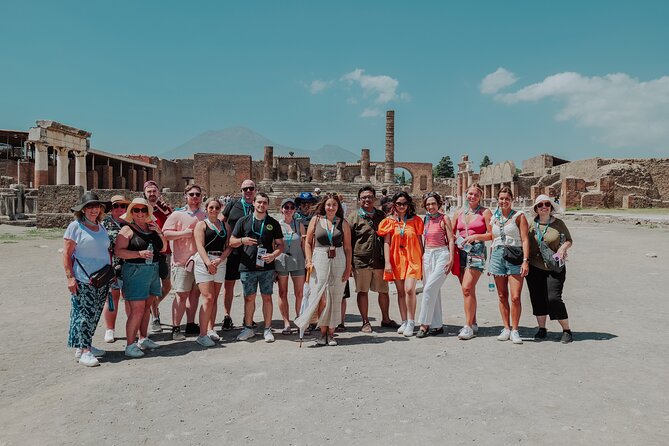
Pompeii and Vesuvius belong together. One is the city destroyed by the eruption of AD 79. The other is the volcano that still shapes the Bay of Naples and can sometimes release visible steam from its upper slopes.
Visiting both in one day gives you a useful connection between the ruins and the mountain. At Pompeii, you see the effects of the eruption in homes, public buildings, casts, and streets. At Vesuvius, you look back across the area and gain a physical sense of the volcano’s scale.
The price is $119.77 per person. For that amount, you receive Pompeii and Vesuvius admission, a two-hour archaeologist guide at Pompeii, minivan transportation to the volcano and back, and a licensed hiking guide. I consider that fair value if you want both sites and prefer a planned day over separate tickets and transport.
The price makes less sense if you want a slow, detailed day at Pompeii. The archaeological park is large, and two hours only gives you a carefully chosen introduction. Several people found themselves wishing they could spend the whole day with their Pompeii guide.
More Vesuvius and Pompeii Tours in Pompeii:
- Naples: Pompeii and Mt. Vesuvius with Lunch and Wine Tasting
★ 4.5 · 2,454 reviews - From Pompeii: Bus Transfer to Vesuvius with Park Entry Fee
★ 4.4 · 1,205 reviews - From Pompeii/Naples: Vesuvius Easy Transfer and Entry Ticket
★ 4.3 · 660 reviews
Meeting at Porta Marina Superiore
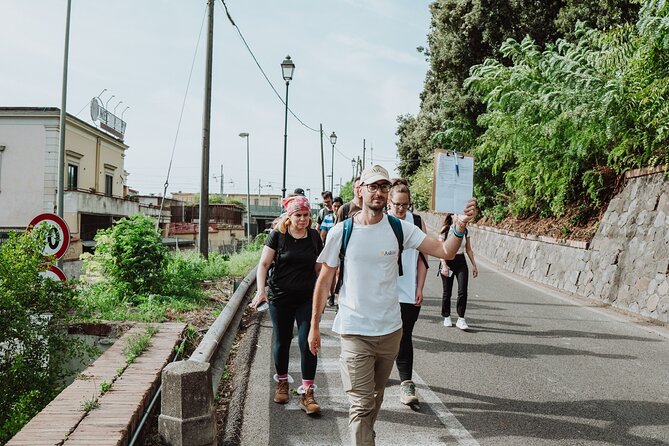
The meeting point is at Via Villa dei Misteri, 2, near Pompeii’s Porta Marina Superiore entrance. Look for the guide holding an Askos Tours sign. Arriving at the correct gate matters because Pompeii has more than one entrance, and a wrong turn can cost you valuable time.
The tour is offered in English. Confirmation comes at booking, and the maximum minibus group is 14 people. The Pompeii section can be slightly larger, with up to 20 people, so do not assume both parts will have exactly the same group.
Timing can vary. Some departures begin with Pompeii and then go to Vesuvius. Others have taken the volcano first, followed by Pompeii. The full experience is advertised at about eight hours, though several accounts describe a shorter day of roughly six hours or a long day depending on the order, transport, and conditions.
That variation is worth keeping in mind if you are planning a train, dinner, or airport transfer afterward. Give yourself breathing room.
Pompeii’s Forum and main streets
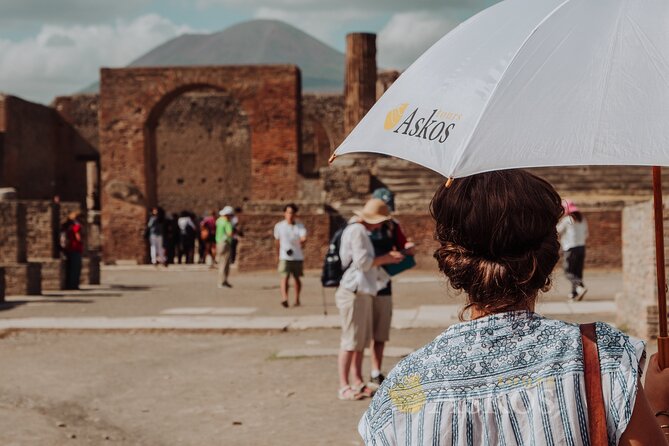
The Pompeii visit lasts about two hours with an archaeologist. That guide is the key reason to choose this tour instead of wandering alone with a map.
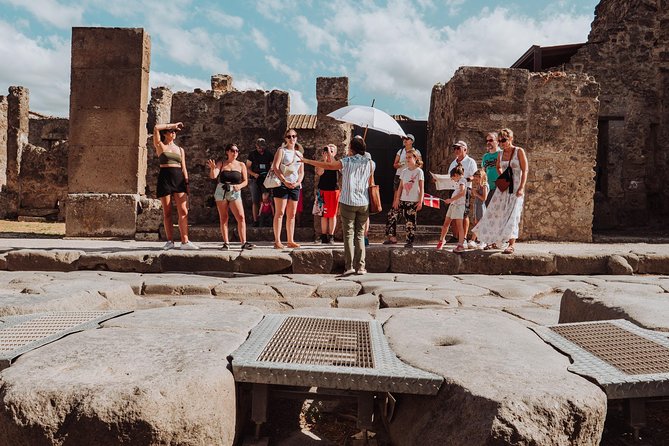
The first major stop is the Forum, Pompeii’s central public square. This is where the city’s political, religious, and commercial life came together. A guide can help you read the broad open space, surrounding buildings, columns, and surviving fragments as parts of a working city rather than isolated stones.
From there, you walk along Pompeii’s main street. The paving stones, sidewalks, storefronts, fountains, and building fronts give you a sense of how people moved through town. The uneven ancient surfaces also provide your first warning about footwear. Comfortable shoes are not a polite suggestion here. They are part of the equipment.
An archaeologist can also point out current excavations and explain why some areas look newly exposed while others have been studied for generations. Guides including Anna Sorrento, Benedetto, Antonella, Teresa, and Giulia have been praised for linking the visible ruins with ongoing archaeological work.
Granaries, casts, and the human cost
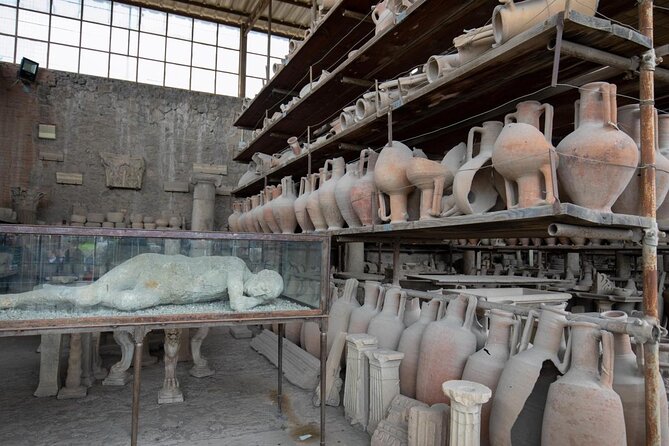
The Forum granaries offer one of the most affecting stops. You see marble tables and fountain basins that once decorated house entrances, along with casts of eruption victims. The casts include a dog and a tree, details that make the disaster feel less like a distant textbook event.
This is not a light sightseeing stop. The casts can be upsetting, especially for children, and children under six are not permitted on the tour. Your guide’s explanation helps place them in context without turning the moment into spectacle.
Pompeii works best when you allow time for these changes in mood. One minute you are studying a decorative wall or street layout. The next, you are confronted with the suddenness of the eruption and the ordinary lives interrupted by it.
A few more volcano trips around Pompeii worth a look
- Pompeii: Mount Vesuvius Crater Transfer with Ticket
★ 4.0 · 541 reviews - Pompeii Guided Tour & Horse Riding on Vesuvius with Lunch
★ 5.0 · 419 reviews - Private Day Tour to Vesuvius, Herculaneum & Pompeii with Pick Up
★ 5.0 · 279 reviews - Pompeii: Day Tour of Pompeii and Vesuvius with Bus Transfer
★ 4.2 · 250 reviews
Houses that reveal Roman life
The House of Menander is one of the tour’s strongest residential stops. It was among Pompeii’s grander homes, with impressive architecture, decoration, and contents. Here, your guide can explain how wealth shaped private space, movement through the house, and the display of status.
The House of the Faun gives you another look at elite Roman living. It was one of the largest private residences in Pompeii, and its scale helps you understand the gap between a wealthy household and the smaller homes elsewhere in town.
These houses are much easier to appreciate with context. Without a guide, you may notice courtyards, rooms, mosaics, and walls but miss the clues about social rank and domestic life. Guides with archaeological experience have been praised for making those clues visible.
The tradeoff is time. You will see important rooms, but you will not examine every corner of either house. If you have visited Pompeii before or want to focus on art and architecture, consider staying after the guided portion if the schedule allows. The tour ends back at the main Pompeii entrance, so you may have some freedom to continue, but confirm the exact plan on the day.
Baths, brothel, and theaters
The Stabian Baths occupy a large area near Via Stabiana and several crossroads. They are considered the oldest thermal complex in the city. The baths help explain how Romans combined washing, exercise, conversation, and public social life.
The Lupanar, Pompeii’s famous brothel, is another brief but memorable stop. Its small rooms and surviving imagery offer a blunt look at commercial sex in the Roman city. The guide’s explanation matters here because the building is easy to misunderstand if you treat it as a curiosity rather than part of urban life.
You also see the Teatro Piccolo, or small theater, and the Teatro Grande, Pompeii’s principal theater. These stops broaden the visit beyond homes and disaster. Pompeii was not simply a collection of private buildings. It was a city with performances, politics, bathing, business, religion, and entertainment.
The listed stop times are short, often 10 to 15 minutes. That keeps the group moving but can feel rushed if you want photographs or detailed study. The two-hour Pompeii section is best viewed as an expert introduction, not a complete archaeological survey.
The minivan ride to Vesuvius
After Pompeii, you transfer by modern minivan toward Mount Vesuvius. The ride is included, which removes one of the more awkward parts of doing the sites independently. The road is winding, and one account found the bends a little nerve-racking, but the driver is an important part of getting safely to the upper access point.
On the way, the Vesuvius guide may explain the volcano, the eruption, nearby towns, and the continuing risk to the surrounding area. Mario receives especially strong praise for giving clear explanations while also keeping an eye on the group’s different walking speeds.
Bring food with you or use the break wisely. Food and drinks are not included, and the interval can be only 10 to 15 minutes in some schedules. Cafés near Pompeii sell sandwiches and drinks, but you should not count on a leisurely restaurant meal between the two sections.
The final 500 meters to the crater
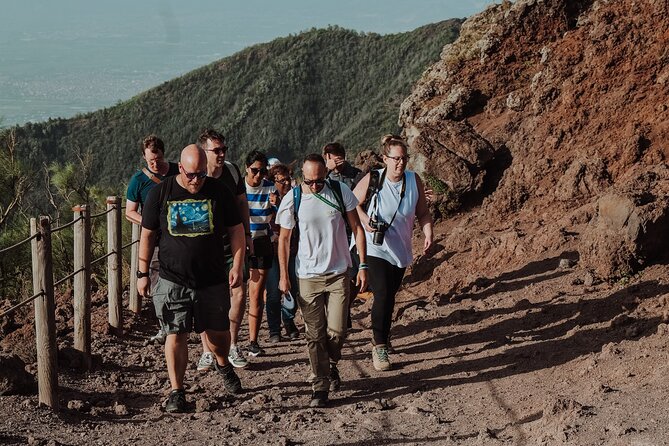
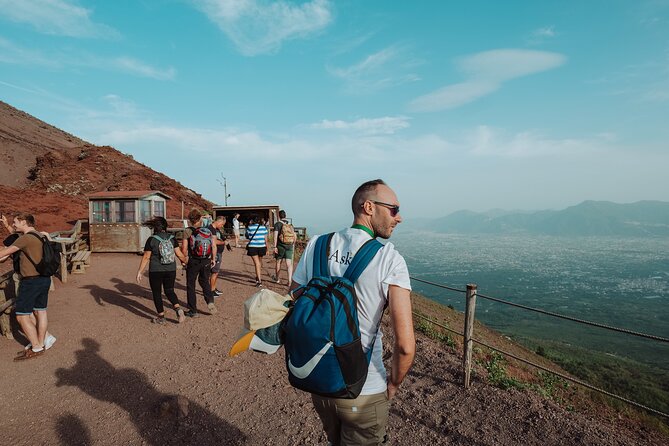
The Vesuvius section includes about two hours in the national park. From the drop-off point, you walk uphill toward the crater. The first 30 minutes are step-heavy, and the final 500 meters are described as a very steep uphill walk.
The trail is not a technical mountain climb, but it is more demanding than a casual stroll. Loose volcanic sand can be slippery, especially on the descent. In summer heat, the climb becomes harder. In cold or wet conditions, wind and mud can change the experience quickly.
Wear closed shoes with a firm sole. Trainers may be adequate in dry weather, but hiking shoes are a wiser choice. Add sunglasses, sunscreen, water, and a light jacket. Several people found the summit chilly or windy even after a hot climb.
The guide should set a manageable pace and allow breaks. Mario has been praised for patience with mixed fitness levels and for encouraging people who were unsure they could finish. Still, you should judge your own ability honestly. The tour is not recommended for people with mobility or walking impairments, and a moderate fitness level is required.
At the crater’s edge, you may see faint smoke or steam. On a clear day, the reward is a broad view across the Bay of Naples toward Capri, Ischia, the Sorrento coast, and the surrounding area. A volcanist may also be present at the summit to explain eruptions and volcanic activity.
Weather controls the quality of this part. Fog can hide the crater even when you are standing beside it. Rain, strong wind, or thick cloud can close the trail altogether. One poor-weather outing continued despite very low visibility, which shows why you should not book this day only for photographs.
What happens when Vesuvius closes?
If Vesuvius cannot be accessed because of force majeure, the stated alternative is Herculaneum. This is a strong backup because Herculaneum is smaller and often easier to follow in wet conditions, with many details preserved at close range.
The substitution is not identical. If your main goal is to look into the crater, Herculaneum will not replace that experience. But it can turn a weather failure into another worthwhile archaeological visit.
The important point is to ask clearly what happens if conditions deteriorate after transport begins. The supplied information says Herculaneum is included when Vesuvius is inaccessible, but one poor-weather account raised concerns about refund communication after the volcano portion was canceled. I would keep all confirmation details and ask the guide or operator about the current policy before departure.
Guides are the strongest part
The best feature here is not the minivan. It is the quality of the guides.
At Pompeii, an archaeologist gives you a framework for understanding streets, houses, public buildings, and excavation work. Anna Sorrento was described as an archaeologist actively working at Pompeii, while Benedetto was praised for long experience with excavations. Guides such as Raffaela, Teresa, Daniela, Giulia, and Antonella were also singled out for clear explanations, warmth, humor, and enthusiasm.
At Vesuvius, Mario is repeatedly praised for patience, geology explanations, and a calm approach to mixed fitness levels. That matters because the group may include strong hikers, hesitant climbers, teenagers, and people who need regular pauses.
There are occasional weak points. Headsets have not always worked well, some guides have been difficult for individuals to understand, and communication between the Pompeii and volcano guides has sometimes been unclear. These problems do not define the whole experience, but they are reasons to listen carefully when the meeting instructions are given.
Who should book this day?
I would choose this tour if you have one full day near Pompeii and want both archaeology and geology without arranging every ticket and transfer yourself. It suits first-time visitors, families with older children, history fans, and anyone who values a guide’s interpretation more than wandering alone.
I would be cautious if you have limited mobility, dislike steep walks, or want a relaxed Pompeii visit. It is also a poor match if you need guaranteed volcano views. Vesuvius is weather-dependent, and even an open trail can be wrapped in fog.
The cancellation policy allows a full refund if you cancel at least 24 hours before the local start time. Changes or cancellations inside that window are not accepted for a refund.
Should you book the Pompeii and Vesuvius tour?
Book it if you want an efficient, guided introduction to both sites. The archaeologist-led Pompeii visit is the real foundation, and the Vesuvius climb adds a memorable physical connection to the eruption.
Go in with realistic expectations. Pompeii will feel abbreviated, the climb is strenuous for some people, and bad weather can remove the volcano views. Wear proper shoes, carry water and sun protection, plan a quick lunch, and leave extra time after the tour. With those conditions in mind, the $119.77 cost is reasonable for the access, transport, tickets, and expert help packed into one day.
FAQ
Where does the Pompeii and Mount Vesuvius tour begin?
It begins at Via Villa dei Misteri, 2, near Pompeii’s Porta Marina Superiore entrance. The guide holds an Askos Tours sign.
How long does the tour last?
The advertised duration is approximately eight hours. The exact length can vary depending on the order of the visits, transport, weather, and operating conditions.
Is admission to Pompeii included?
Yes. The Pompeii Express admission fee is included in the tour price.
Is Mount Vesuvius admission included?
Yes. The Mount Vesuvius entry fee is included. The supplied information lists the ticket value as 11 euros.
How large is the group?
The minibus portion has a maximum of 14 people. The archaeologist-guided Pompeii group can include up to 20 people.
How difficult is the Mount Vesuvius walk?
The walk includes about 30 minutes of steps from the entrance area and a steep final 500-meter climb toward the crater. A moderate fitness level is required, and the tour is not recommended for people with mobility or walking impairments.
What should I wear for Vesuvius?
Wear comfortable closed shoes. Sunglasses and sunscreen are useful in summer, and a light jacket can help because the summit may be windy or chilly.
What happens if Mount Vesuvius is closed?
If Vesuvius is inaccessible because of force majeure, the stated alternative is a visit to Herculaneum.
Is food included?
No. Food and drinks are not included, so you need to plan for lunch or snacks during the break between the two sections.
Just added around Pompeii
- Wine tasting in the Vesuvius national park★ 5.0 · 3 reviews
- Vesuvius tour entrance to the crater and return bus★ 4.5 · 9 reviews
- Mt. Vesuvius Wine Tasting and Lunch Experience from Pompeii★ 4.5 · 20 reviews
- Tour Mount Vesuvius with Entry Tickets and Round Trip Transfer Included★ 3.5 · 4 reviews
- Skip-the-Line Pompeii & Volcano Vesuvius Day Tour w Hotel or Port Pickup★ 5.0 · 28 reviews
- Sunset Experience at Vesuvius★ 4.0 · 3 reviews
- Pompeii: living with the volcano★ 5.0 · 5 reviews
- Trip Excursion to Mt. Vesuvius – Pompeii + Handmade pasta class with lunch★ 5.0 · 5 reviews
Mount Vesuvius & Pompeii Tours, compared.

Pompeii and Mount Vesuvius Day Trip from Rome with Pizza Lunch
Our review of it →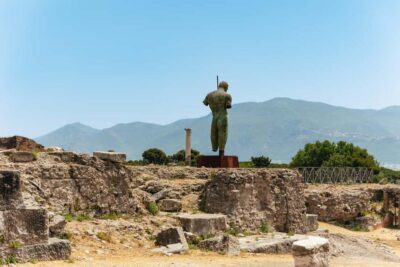
Pompeii Day Trip with Optional Vesuvius and Lunch
Our review of it →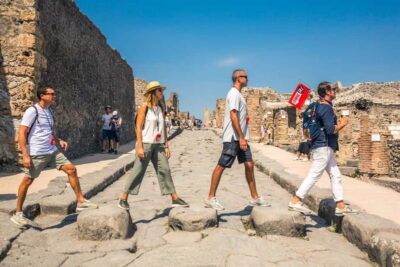
Naples or Sorrento: Full-Day Pompeii and Mount Vesuvius Tour
Our review of it →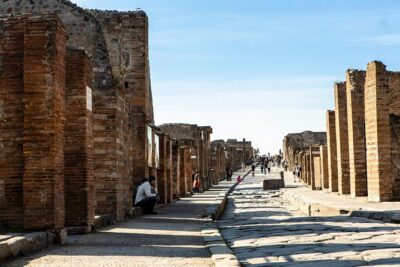
Pompeii & Mt.Vesuvius Day Tour from Naples with Pizza Lunch
Our review of it →
Mount Vesuvius: Skip-the-Line Ticket and Smart Digital Guide
Our review of it →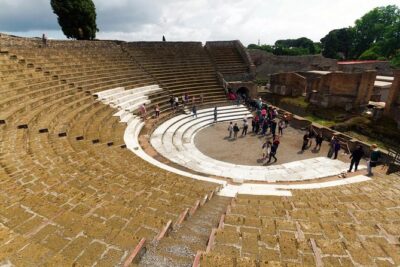
Pompeii & Mt Vesuvius All-Inclusive Small Group w/ Lunch
Our review of it →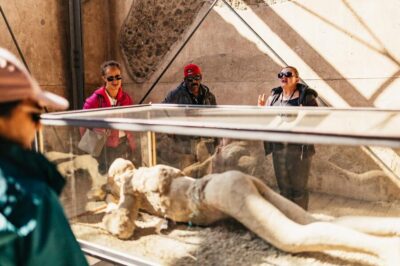
Pompeii and Mt. Vesuvius with Lunch and Wine Tasting
Our review of it →Browse the lists this tour appears in