
REVIEW · POMPEII
Exclusive Pompeii with Wine and Lunch on Vesuvius-Skip-the-line
Pompeii rewards a guide. This private experience pairs skip-the-line entry and hotel pickup with a focused walk through the Forum, villas, baths, theaters, and ancient streets. I especially like the private format and the easy finish at Russo Family Winery, where five wines and a three-course Campanian lunch follow the ruins. The main drawback is the price, $575.35 per person, and the standard option gives you about two hours inside Pompeii.
The tour works best if you want one well-organized day rather than separate bookings for transport, tickets, a guide, and lunch. You can also upgrade to Premium Plus for a longer three-hour Pompeii visit and the Villa of the Mysteries. Just remember that this is not a climb of Mount Vesuvius, despite the winery setting and volcano views.
Key points at a glance
- Private guide-led Pompeii visit: Your group explores with a certified guide, at a pace that can be adjusted for special needs.
- Skip-the-line admission: Included tickets save time at one of Italy’s most crowded archaeological sites.
- Two Pompeii options: The regular visit lasts about two hours, while Premium Plus adds a three-hour tour and the Villa of the Mysteries.
- Pickup across the Bay of Naples area: Collection is available from hotels, vacation rentals, train stations, airports, and cruise ports in Naples, Sorrento, Pompeii, and nearby areas.
- Wine and lunch on Vesuvius: Russo Family Winery offers five wines, a vineyard and cellar visit, and a three-course meal made with local ingredients.
- A polished private day: The strongest praise goes to the guides and drivers, including Natalia, Fabio, Dino, Danilo, Paola, Giuseppe, and Fabrizio.
Why a private Pompeii tour makes sense
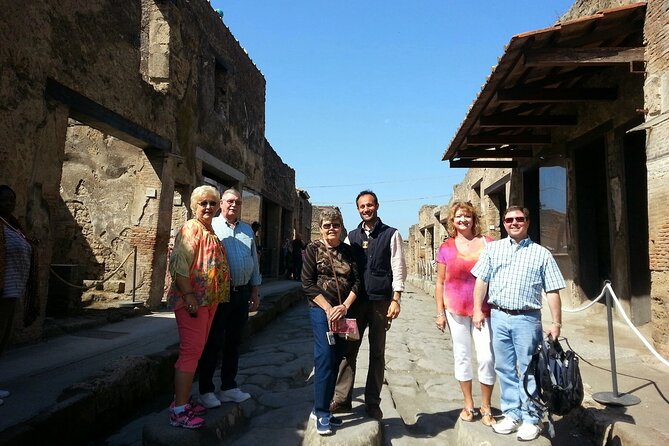
Pompeii is far larger than many people expect. It is not a compact ruin with a few tidy streets and one famous square. You walk past homes, shops, temples, baths, theaters, food markets, painted walls, and streets buried under ash and pumice after the eruption of Mount Vesuvius in AD 79.
That scale is where a private guide earns the fee. Without help, you can spend your time looking at stones without knowing what you are seeing. A guide can connect a painted dining room to Roman domestic life, explain how the baths worked, and show why the Forum mattered to politics, religion, and trade.
I also like the private format because you are not tied to the pace of a large group. The walking route can be adjusted for your interests and needs. One guide, Danilo, received special praise for paying attention to a guest’s mobility issues, which is a useful sign for anyone who needs a more considerate pace.
The transportation adds another layer of ease. Pickup can be arranged from a hotel, rental, train station, airport, or cruise terminal in Naples, Sorrento, Pompeii, and nearby areas. Drivers such as Dino and Fabio were praised for punctuality, smooth driving, and handling the busy Naples roads. That matters in this part of Italy, where a day that starts with a missed connection can become stressful very quickly.
More Vesuvius and Pompeii Tours in Pompeii:
- Naples: Pompeii and Mt. Vesuvius with Lunch and Wine Tasting
★ 4.5 · 2,454 reviews - From Pompeii: Bus Transfer to Vesuvius with Park Entry Fee
★ 4.4 · 1,205 reviews - From Pompeii/Naples: Vesuvius Easy Transfer and Entry Ticket
★ 4.3 · 660 reviews
Entering Pompeii through Porta Marina
The visit begins at the Archaeological Park of Pompeii, with admission included. Skip-the-line access is a practical advantage, especially during busy periods when the entrance area can slow you down before you have seen a single Roman wall.
Porta Marina was one of Pompeii’s main gates. It connected the city with the port area and gave arriving merchants, sailors, and other visitors access to the ancient streets. You can still see the original stone ramp and defensive walls, which provide a useful first lesson: Pompeii was a working city with trade, security, and movement, not just a collection of grand houses.
The stop itself is short, but it helps orient you. Your guide can explain how the gate related to the rest of the city before leading you toward the public center.
The Forum, Basilica, and Temple of Apollo
The Basilica occupies the southwestern corner of the Forum and was one of Pompeii’s most important public buildings. Dating from the second century BC, it predates much of the city’s later Roman decoration. Even a brief stop helps you see how old Pompeii was before the eruption.
Next comes the Temple of Apollo, one of the city’s oldest religious sites. Its open courtyard once held columns and statues, including a bronze Apollo shown aiming his bow. The temple is close to the Forum, so the route gives you a quick look at how worship and civic life were placed side by side.
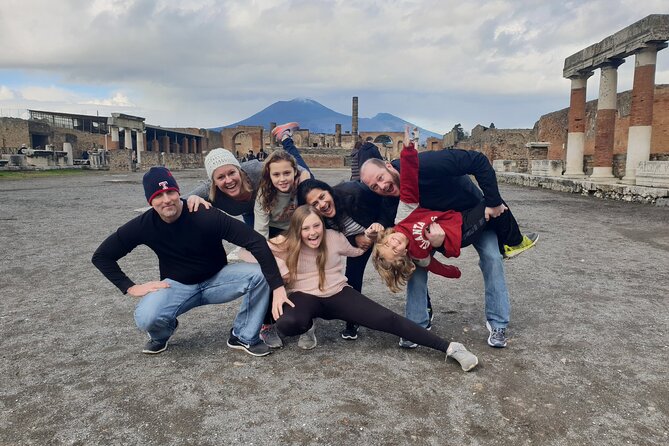
The Forum was Pompeii’s public heart. From the walkways and terraces, you can understand the layout more easily than you can from street level. The Capitolium, Basilica, and Macellum frame the square, showing how religious ceremonies, government business, announcements, and commerce shared one monumental space.
Ten minutes at the Forum may sound short, but a good guide can make that time count. The limitation is that you will not have long to linger over every building in the regular two-hour format. If you enjoy taking many photos or reading every sign, Premium Plus is the better fit.
Food, bathing, and the daily Roman routine
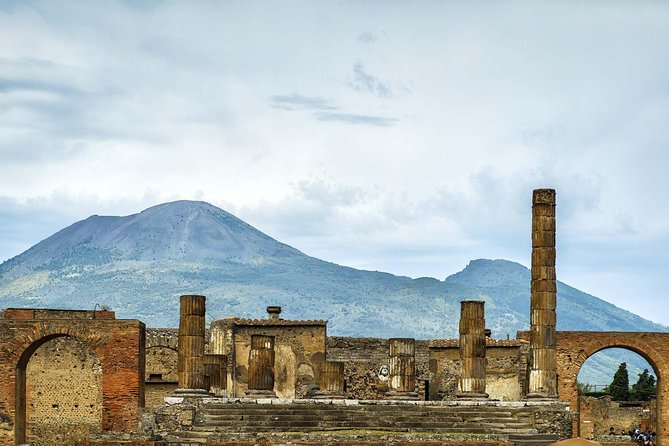
The Macellum was Pompeii’s main food market. Its stalls, storerooms, counters, marble tables, and central shrine reveal how an ancient city organized food sales. Fish, meat, fruit, and imported products passed through this market, making it one of the best stops for picturing ordinary shopping.
The Forum Baths show another side of daily life. The complex had separate men’s and women’s areas, changing rooms, warm and hot rooms, and a cold plunge pool. An underfloor heating system, called a hypocaust, warmed the bathing rooms.
The surviving stucco reliefs and vaulted ceilings help explain why bathing was more than washing. It was also a social routine and a place for conversation. I find this kind of stop more useful than simply seeing another temple because it shows how Roman engineering shaped normal life.
The guide also helps you notice the smaller details: flooring, wall decoration, room layout, and the way public buildings were heated or supplied. Pompeii becomes easier to understand when you move between major monuments and these practical spaces.
More Wine Tours in Pompeii:
- Lunch & Wine Tasting in the National Park of Mt Vesuvius
★ 5.0 · 179 reviews - Scenic Horseback Ride, Wine Tasting & Lunch on Mt. Vesuvius
★ 5.0 · 23 reviews - Pompeii Small Group Tour & Food/Wine tasting at Mt. Vesuvius
★ 4.5 · 21 reviews - Mt. Vesuvius Wine Tasting and Lunch Experience from Pompeii
★ 4.5 · 20 reviews
Inside the House of the Vettii
The House of the Vettii is one of Pompeii’s finest private residences. It was arranged around atriums and gardens, with decorated rooms that reflect the taste and ambitions of wealthy merchant owners in the first century AD.
The frescoes include mythological scenes and ornamental designs. They are not just pretty surfaces. They show how the owners wanted visitors to see them, what subjects they valued, and how Roman homes could function as settings for status and display.
This is a strong stop for anyone interested in art, architecture, or domestic life. It also gives the route a human scale. After the Forum and its official buildings, you enter a home and start thinking about meals, guests, household work, and private comfort.
Working life at the Insula of the Chaste Lovers
The Insula of the Chaste Lovers combines homes, workshops, storage areas, and painted decoration in one urban block. Its name comes from a fresco showing a pair of lovers sharing an affectionate moment.
Modern raised ramps let you look down into the rooms without walking across fragile archaeological surfaces. That viewpoint is especially useful here because you can see how trade and home life occupied the same block. Craftsmen worked near family spaces, and daily routines unfolded close to shops and storerooms.
Painted signs, frescoes, and unfinished repairs suggest a neighborhood interrupted in the middle of ordinary work. This is one of the more revealing parts of the route because it moves away from elite villas and shows a working section of Pompeii.
A short look at the Teatro Grande
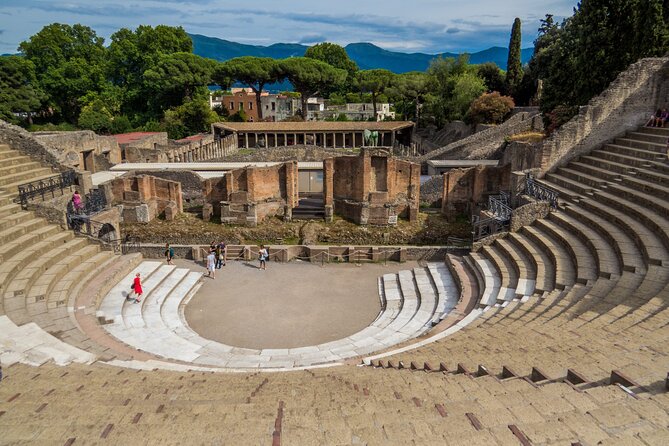
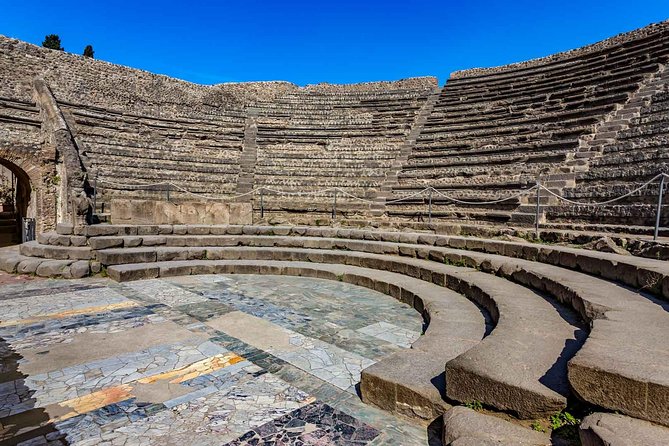
The Teatro Grande was Pompeii’s main setting for drama and public entertainment. From the upper walkways, you can look across the semicircular seating, stage building, and orchestra area.
The theater is well preserved enough to explain how a performance worked. Comedies, tragedies, music, dancing, and public ceremonies all belonged here. The acoustics and views toward the city and Vesuvius also help you picture why the building could draw a crowd.
The planned stop is brief, about five minutes. Think of it as a sharp introduction rather than a long theater study. If this is the part of Pompeii you most want to explore, ask about the pace when you book.
Antiquarium and the human cost of the eruption
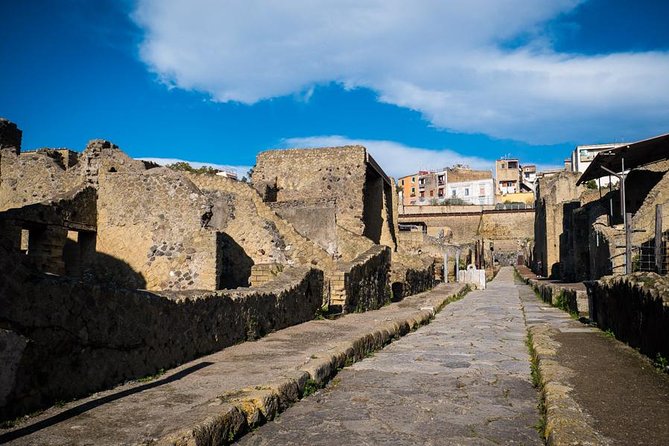
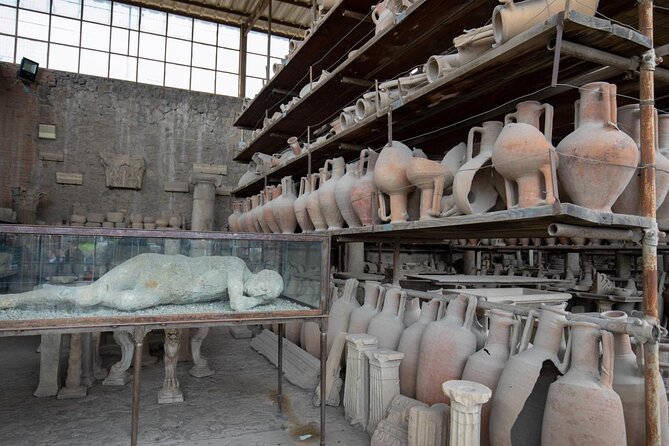
The Antiquarium provides context before or after the outdoor ruins. Its displays include statues, household objects, inscriptions, jewelry, and other objects recovered during excavation.
This is where smaller finds can make Pompeii feel personal. A domestic object or inscription tells you more about a household than another stretch of wall. Panels and reconstructions also help explain religion, daily life, and the eruption.
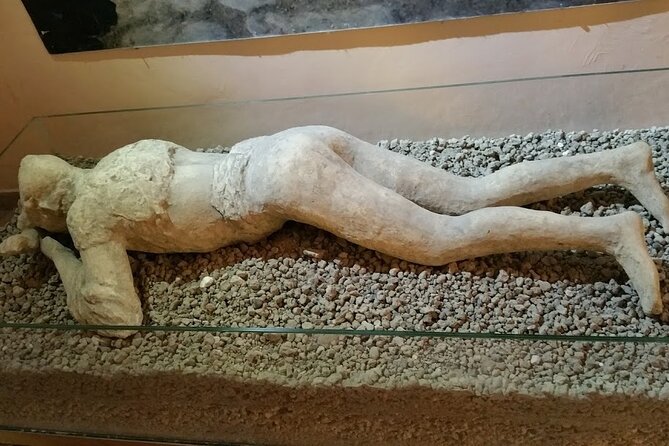
The plaster casts of victims are among the most emotional parts of the visit. The ash and pumice that buried Pompeii preserved the spaces left by human bodies, creating a direct and difficult record of AD 79. I would not rush this section. It changes the tone of the day and reminds you that Pompeii is not only an archaeological puzzle.
The Premium Plus case for Villa of the Mysteries
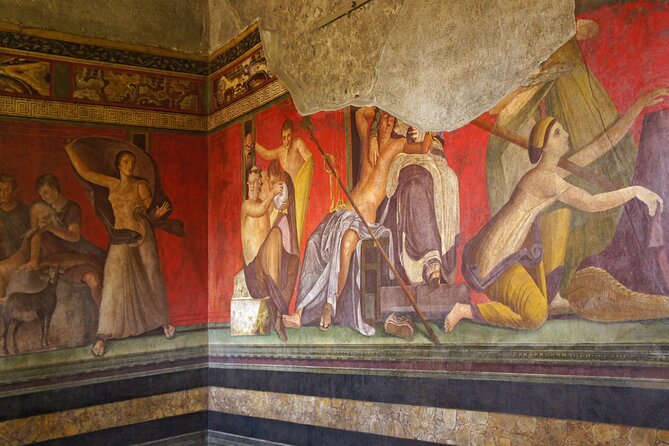
The regular option covers the main Pompeii highlights in roughly two hours. Premium Plus extends the private guided visit to three hours and adds the Villa of the Mysteries, located outside the ancient city walls.
The villa is famous for its preserved frescoes showing a mysterious Dionysian ritual. It is a worthwhile upgrade if you want more art, more context, and more time to walk without watching the clock.
The upgrade makes less sense if your group has young children, limited stamina, or only wants the main public buildings before lunch. Pompeii requires a fair amount of walking, and three hours among the ruins can feel demanding in strong sun. Wear supportive shoes and bring sun protection from May through September.
Lunch and five wines at Russo Family Winery
After Pompeii, the tour continues to Cantina del Vesuvio, also called Russo Family Winery. The Russo family has operated the winery since 1930, and the property sits on the slopes of Vesuvius with views across the Bay of Naples.
You receive a guided vineyard and cellar visit, followed by a tasting of five wines. The focus includes Lacrima Christi, the local wine associated with the volcanic soil around Vesuvius. The setting gives the day a welcome change of pace after the hard stone streets of Pompeii.
The three-course lunch is substantial rather than a token snack. It begins with salami, provolone, ricotta, casatiello, roasted eggplant, and bruschetta topped with Piennolo tomatoes. The pasta course features Piennolo cherry tomatoes and basil. Dessert is Neapolitan pastiera, made with ricotta, cooked wheat, and candied fruit.
Vegetarian, vegan, and gluten-free meals are available, but you should identify your needs when booking. The lunch is one of the strongest reasons to choose this experience instead of a Pompeii-only visit. You get local food, a family-run winery, and a relaxed setting after a history-heavy morning.
The tour does not include a hike to the crater or an ascent of Mount Vesuvius. You will see the volcano during the day, including from the winery, but this is a wine and Pompeii experience, not a volcano-climbing excursion.
Price, timing, and overall value
At $575.35 per person, this is an expensive day. The price makes more sense for a couple, family, or small private group that values convenience and personal attention than for a solo visitor trying to keep costs low.
You are paying for private transport, a private certified guide, included Pompeii admission, skip-the-line access, a winery visit, five tastings, and a full local lunch. Booking each part independently might reduce the price, but it would also leave you managing transfers, entrance times, and restaurant arrangements.
The standard tour lasts about five to seven hours, depending on pickup location and timing. I would allow the full window rather than planning another fixed appointment immediately afterward. Naples traffic, the time needed to get between Pompeii and the winery, and the pace of your private visit can all affect the day.
The tour is offered in English and includes mobile tickets. Full names are required for admission tickets, so provide them carefully when booking. Free cancellation is available up to 24 hours before the start time. Changes or cancellations inside that window are not refunded.
Who should book this Pompeii and winery day?
I would recommend it to you if you want Pompeii explained rather than simply entered. It is also a good match if you are arriving by cruise ship, staying in Naples or Sorrento, or prefer a driver to handle the road connections.
The experience suits couples, families, and private groups that enjoy history but also want an easy lunch and wine tasting. It is especially useful for anyone who finds a huge archaeological site overwhelming. The guide can set the pace, answer questions, and focus on the areas you care about most.
I would hesitate if your main goal is to climb Vesuvius, spend half a day taking detailed architectural photographs, or keep your budget modest. The regular visit moves briskly through many stops, and the Premium Plus option costs more. Pompeii also involves substantial walking, so shoes and sun protection matter.
The praise for the staff is unusually consistent. Natalia was singled out for storytelling and enthusiasm, while Dino and Fabio were appreciated for punctual, calm driving. Giuseppe, Paola, Danilo, and Fabrizio were also praised for their warmth, clear explanations, and personal attention. Those names cannot guarantee who you will receive, but they show the human side of the service and why the private format works well.
Should you book it?
Book this tour if you want a smooth, private day that joins Pompeii’s major sights with a proper meal and wine tasting. Choose Premium Plus if the Villa of the Mysteries and extra time inside Pompeii matter to you.
Skip it if you only want the cheapest entrance ticket or if a Vesuvius climb is your priority. For everyone else, the high price buys real convenience and a more understandable visit to a site that can otherwise feel too large to grasp.
FAQ
Is Mount Vesuvius included as a climb?
No. The tour does not include a climb to Mount Vesuvius. You will see the volcano during the Pompeii visit and from Russo Family Winery.
How long does the experience last?
The full experience lasts approximately five to seven hours. The Pompeii visit is about two hours in the regular option, followed by about two hours at the winery.
What does Premium Plus add?
Premium Plus provides an extended three-hour private guided visit in Pompeii and includes the Villa of the Mysteries.
Is hotel pickup available?
Yes. Pickup is offered from hotels, vacation rentals, train stations, airports, and cruise terminals or ports in Naples, Sorrento, Pompeii, and nearby areas.
Is transportation private?
Yes. This is a private activity, and only your group participates.
Is lunch included?
Yes. The winery portion includes a three-course lunch with local ingredients, along with a tasting of five wines.
Are vegetarian, vegan, and gluten-free meals available?
Yes. Vegetarian, vegan, and gluten-free options are available.
Is the tour offered in English?
Yes. The experience is offered in English.
What should I wear?
Wear appropriate walking shoes. Sun protection is recommended from May through September, and you should expect a moderate level of physical activity.
More Skip the Line in Pompeii
- Skip-the-Line Pompeii & Volcano Vesuvius Day Tour w Hotel or Port Pickup
★ 5.0 · 28 reviews - Mount Vesuvius: Skip-the-Line Ticket and Smart Digital Guide
★ 4.2 · 2,780 reviews - Skip-the-Line Pompeii & Mt. Vesuvius Day Trip from Naples
★ 4.5 · 680 reviews - Vesuvius National Park Skip-the-Line Ticket
★ 3.8 · 221 reviews
More Lunch Experiences in Pompeii
- Pompeii Guided Tour & Horse Riding on Vesuvius with Lunch
★ 5.0 · 419 reviews - From Naples: Pompeii and Vesuvius Tour with Lunch Included
★ 4.5 · 19 reviews - Trip Excursion to Mt. Vesuvius – Pompeii + Handmade pasta class with lunch
★ 5.0 · 5 reviews - Pompeii and Mount Vesuvius Day Trip from Rome with Pizza Lunch
★ 4.5 · 6,151 reviews
Just added around Pompeii
- Wine tasting in the Vesuvius national park★ 5.0 · 3 reviews
- Vesuvius tour entrance to the crater and return bus★ 4.5 · 9 reviews
- Mt. Vesuvius Wine Tasting and Lunch Experience from Pompeii★ 4.5 · 20 reviews
- Skip-the-Line Pompeii & Volcano Vesuvius Day Tour w Hotel or Port Pickup★ 5.0 · 28 reviews
- Sunset Experience at Vesuvius★ 4.0 · 3 reviews
- Tour Mount Vesuvius with Entry Tickets and Round Trip Transfer Included★ 3.5 · 4 reviews
- Pompeii: living with the volcano★ 5.0 · 5 reviews
- Trip Excursion to Mt. Vesuvius – Pompeii + Handmade pasta class with lunch★ 5.0 · 5 reviews
Mount Vesuvius & Pompeii Tours, compared.

Pompeii and Mount Vesuvius Day Trip from Rome with Pizza Lunch
Our review of it →
Pompeii Day Trip with Optional Vesuvius and Lunch
Our review of it →
Naples or Sorrento: Full-Day Pompeii and Mount Vesuvius Tour
Our review of it →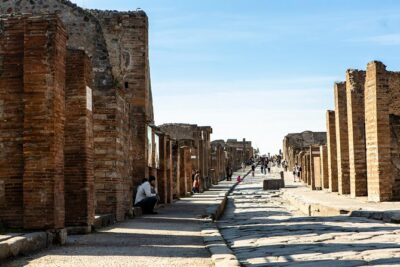
Pompeii & Mt.Vesuvius Day Tour from Naples with Pizza Lunch
Our review of it →
Mount Vesuvius: Skip-the-Line Ticket and Smart Digital Guide
Our review of it →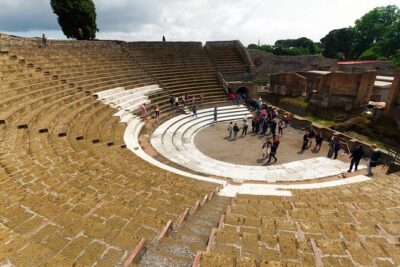
Pompeii & Mt Vesuvius All-Inclusive Small Group w/ Lunch
Our review of it →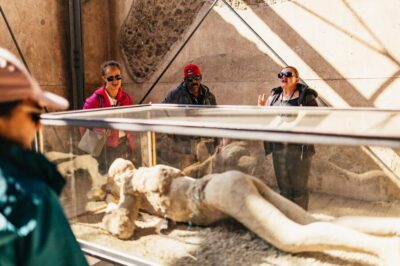
Pompeii and Mt. Vesuvius with Lunch and Wine Tasting
Our review of it →Browse the lists this tour appears in